DOWNLOAD & SAVE THIS POST >> CLICK HERE <<
Written by the PromoteLabs team. Updated November 2026.
To start an online business in 2026, choose an idea you can test quickly, validate it with real people, pick a simple business model, set up only the essentials, focus on your first ten customers and then build systems so you can grow.
Many successful online businesses started as something small: a side service done in the evenings, a simple template sold to friends, a newsletter with 40 subscribers. Very few started with a big launch, a perfect logo or a complicated website. What the successful ones have in common is the order they did things in. They tested an idea, found their first customers and only then built the rest. This guide walks you through that order.
How to Start an Online Business in 2026
Starting a business online has never cost less. You can test an idea with a free website builder, an email account and a few hours a week. But low cost does not mean low effort, and most new businesses stall for the same few reasons: the idea was never tested, the founder tried to do everything at once, or there was no plan for getting customers. The steps below give you a simple order to work in, whether you are starting a side business or going full time.
Step 1: Choose an Idea You Can Test Quickly
Good starting ideas usually come from one of three places: a skill you already have, a problem you have solved for yourself or a market you know well. Before falling in love with an idea, ask three questions. Do people already spend money on this problem? Can I reach those people? Can I deliver a result without needing large upfront investment? If the answer to all three is yes, you have something worth testing.
Step 2: Validate Before You Invest
Validation means getting real signals from real people before you spend significant time or money. Talk to ten potential customers about their problem. Put up a simple page describing your offer and see who signs up. Offer a small paid pilot to a handful of people. Each of these tells you more than months of planning.
Step 3: Pick a Simple Business Model
| Model | How it makes money | Good for |
|---|---|---|
| Services | Clients pay for your time or a done-for-you result | Fast first income with a skill you already have |
| Digital products | Ebooks, courses, templates and tools sold online | Scalable income with low delivery cost |
| Affiliate marketing | Commissions for recommending other products | Starting without your own product |
| Memberships and subscriptions | Recurring monthly or annual payments | Predictable income over time |
| Ecommerce | Physical or print-on-demand products | Brand-led businesses |
Many successful online businesses start with services for quick cash flow, then add digital products or memberships once they understand their customers better.
Step 4: Set Up the Essentials (and Only the Essentials)
New founders often spend weeks on logos, business cards and complicated websites. At the start you only need a clear offer, a simple website or landing page, an email list, a way to take payments and a basic system for tracking income and expenses. Check the legal and tax requirements where you live, such as registering your business, collecting sales tax where required and keeping records. When in doubt, speak with a qualified accountant or adviser.
Step 5: Get Your First Ten Customers
Your first customers rarely come from ads. They come from your existing network, conversations in communities where your audience gathers, helpful content and direct outreach. Make it easy to say yes: a clear offer, a simple price and a fast way to buy. Ask every early customer for feedback and a testimonial.
Step 6: Build Systems So You Can Grow
Once customers start arriving, write down how you deliver your product or service and look for steps you can template, automate or delegate. Set up a welcome email sequence, a simple project or task system and a weekly review of your numbers. Systems are what let a business grow beyond the founder’s available hours.
Common Start-Up Mistakes to Avoid
- Building in secret. Share your idea early and learn from real reactions.
- Trying every marketing channel at once. Master one before adding another.
- Underpricing. Low prices attract difficult customers and make growth harder.
- Ignoring the numbers. Know your monthly revenue, costs and profit.
- Going it alone. Training, mentors and peers shorten the learning curve.
Your First 90 Days
- Days 1 to 30: choose and validate your idea, define your offer and set up a simple website, email list and payment system.
- Days 31 to 60: reach out to your network, publish helpful content and land your first paying customers.
- Days 61 to 90: collect testimonials, improve your offer, document your process and plan your next product or service.
Every one of these steps is easier with good training, which is exactly why start-up and entrepreneur courses are always in demand.
How AI Can Help You Start Faster
AI assistants such as ChatGPT, Claude and Gemini have become genuinely useful start-up partners. Used well, they can save a new founder dozens of hours in the first few months:
- Idea research: ask AI to list the common problems, objections and buying questions in your market.
- Offer design: describe your skills and audience and ask it to suggest three offers at different price points.
- Website and sales copy: draft your homepage, about page and sales page, then edit them in your own voice.
- Email sequences: plan and draft a five-email welcome sequence for new subscribers.
- Planning: turn your 90-day goals into weekly tasks and a simple checklist.
Always check facts, numbers and legal or tax details with a reliable source or a qualified professional. AI is a fast assistant, not an adviser.
Funding Your Start Without Big Risk
Most online businesses do not need outside investment to get started. Keep your costs low by using free or low-cost tools, start with an offer that can earn money quickly (such as a service or a small digital product), and reinvest early profits into the tools, training and marketing that clearly pay for themselves. Many founders keep a job or part-time income while the business grows, which removes the pressure to make every decision a financial emergency.
Run This Playbook With AI
AI is like having a business partner who never gets tired of your questions. Use these prompts to plan your start-up the smart way.
Prompt 1: Stress-test your idea
Act as a skeptical investor. Here is my business idea: [describe]. List the 7 biggest risks, the questions a customer would ask before buying and the cheapest way to test demand in 14 days.
Prompt 2: Write a one-page plan
Create a one-page business plan for [business] covering customer, problem, offer, price, how I will get the first 10 customers, costs for the first 90 days and the one number I should track weekly.
Prompt 3: Find your first customers
List 15 specific places where [audience] already spends time online and offline. For each, give one non-spammy way I could start a conversation and offer help.
Prompt 4: Build a weekly routine
I have [hours] per week for this business. Build me a weekly schedule that balances building the product, marketing and learning, with one clear goal per week for the next 8 weeks.
Fill in the parts in brackets, then edit what the AI gives you so it sounds like you. AI does the first draft; your experience makes it worth reading.
Want Step-by-Step Training? Get Three Start-Up Courses Free
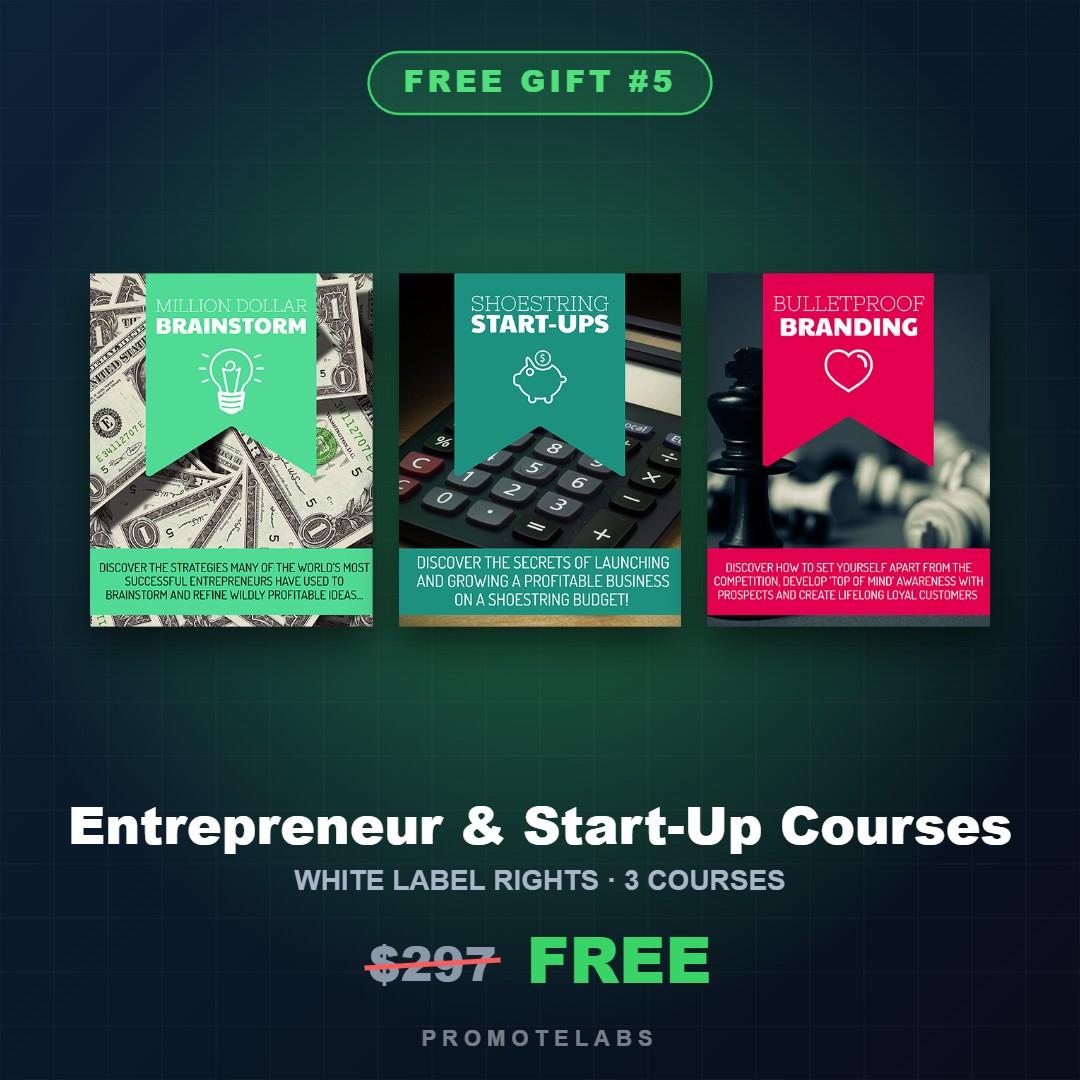
If you would like video training that walks you through starting and growing a business, this gift includes three complete entrepreneur and start-up courses. They come with rights, so you can learn from them, give them away to grow your list or sell them as your own.
The three courses
| Course | Length and materials | What it teaches |
|---|---|---|
| Million Dollar Brainstorm | 1 hr 46 min of video, 35-page workbook, 49-page transcript | Evaluating business ideas, researching an idea in a weekend, seven ways to learn what a market wants, estimating revenue potential and building a prospect list before launch |
| Shoestring Start-Ups | 1 hr 28 min of video, 35-page workbook, 37-page transcript | Prioritising expenses, seven bootstrapping strategies, investing to grow sales, eight funding methods and borrowing without high fees |
| Bulletproof Branding | 1 hr 28 min of video, 35-page workbook, 45-page transcript | A five-step branding process, the 5 Ps of branding, naming and pricing, testing concepts, 11 positioning approaches and 20+ real examples |
Everything else included
- Unbranded sales videos for each course, with scripts.
- Two post-sale follow-up emails per course that cross-sell the other courses.
- Full transcripts in DOCX, ready to turn into books, reports or blog posts.
- A bonus PLR training kit.
Turn the three courses into a funnel
- Lead with Million Dollar Brainstorm. It is the natural first step for anyone with an idea.
- Send the follow-up emails. They introduce Shoestring Start-Ups and Bulletproof Branding to buyers.
- Offer a bundle of all three at a better price for buyers who want everything.
- Add coaching on top for founders who want personal help, using the workbooks as homework.
Other ways to use them
- Add all three to a membership as a start-up track.
- Run a cohort-based class or local workshop.
- Turn the transcripts into an ebook series.
- Use them as bonuses with a paid business product.
What the license allows
| You can | You cannot |
|---|---|
| Sell the courses as-is or in any format, including a membership or continuity offer | Pass resale, PLR or white label rights to your customers |
| Edit, rename, translate or add voiceovers | Reuse the content or sales copy in another PLR product |
| Use them in online or offline coaching | Give them away in their original form |
| Claim authorship, subject to the terms | Claim copyright without substantial changes (at least 50%) |
How to claim it free
- Go to the PromoteLabs free gifts page.
- Find Entrepreneur and Start-Up Courses and copy the coupon on its card.
- Apply the coupon at checkout to bring the price to $0.
Honest notes
- Funding options vary by country. Review the Shoestring Start-Ups funding material for your market before selling it.
- To give the courses away, rebrand them fully first.
Keep reading
Frequently Asked Questions
How do I start an online business?
Choose an idea you can test quickly, validate it with real people, pick a simple business model, set up only the essentials, focus on your first ten customers and then build systems so you can grow.
What is the easiest online business to start?
Services based on a skill you already have are usually the fastest way to earn, because you can start with a simple offer and no product to build. Digital products and affiliate marketing are also popular low-cost options.
How much does it cost to start an online business?
Many online businesses start with very little: a simple website or landing page, an email account and a way to take payments. Keep costs low until your idea is validated.
How do I get my first customers?
Start with your existing network, helpful conversations in communities where your audience gathers, useful content and direct outreach. Make the offer clear and easy to buy.
Can AI help me start a business?
Yes. AI assistants can help with market research, offer ideas, website copy, email sequences and planning. Check facts and get qualified advice on legal and tax questions.
Where can I get free start-up courses?
Three entrepreneur and start-up video courses are one of the free gifts on the PromoteLabs free gifts page.
DOWNLOAD & SAVE THIS POST >> CLICK HERE <<