DOWNLOAD & SAVE THIS POST >> CLICK HERE <<
Written by the PromoteLabs team. Updated November 2026.
To plan your best year yet, review the year you just had before you set anything new, score eight areas of your life to see where the gaps are, choose no more than three focus areas, and check each goal on six factors: clear, measurable, meaningful, in your control, realistic and scheduled. Then break each goal into quarterly milestones and weekly habits, and protect it with a short weekly review.
Think back to last January. You probably had a list of things you wanted to change. Now ask yourself how many of them made it to March. If the answer is “not many,” you are in good company. Most plans fade, not because people are lazy, but because they never had a system to keep the plan alive. A freelance designer who felt her year had been a mess discovered, after one honest review, that her best clients all came from referrals and her best months were the ones where she protected her mornings. Her plan for next year almost wrote itself.
Most years end the same way. A few rushed days of reflection between holidays and deadlines, a list of resolutions written in a hurry, and a fresh start on January 1 that has faded by February. It is rarely a willpower problem. It is a system problem.
This guide gives you a simple year-end planning system you can finish in a single day, whether you are planning your business, your life or both. It also covers how to use AI as a planning partner, and why this exact topic is one of the best lead magnets you can offer your audience between now and the end of January.
Why Most New Year Plans Fail
When plans fall apart, it is usually for one of a handful of predictable reasons. Each one has a simple fix:
| Common trap | Better approach |
|---|---|
| Planning without reviewing the year | Review your wins, lessons and patterns first |
| Too many goals at once | Choose up to three focus areas |
| Vague intentions such as “grow my business” | Run every goal through a six-factor goal check |
| A clear outcome but no actions | Define milestones, habits and a first step |
| One deadline twelve months away | Plan in quarters and weeks |
| No check-ins | Weekly reviews and monthly check-ins |
| All-or-nothing thinking | Plan for setbacks and restart quickly |
The system below follows five stages: review, focus, goals, roadmap and check-ins.
Stage 1: Review Your Year Honestly
Before deciding where you are going, look at where you have been. Block at least an hour, put your phone away and scroll back through your calendar month by month. It is one of the fastest ways to remember what actually happened. Then answer a few questions in writing:
- What were my three biggest wins this year, large or small?
- What did not go to plan, and what did I learn from it?
- What gave me the most energy, and what drained it?
- Which habits helped, and which held me back?
- What did I spend too much time on, and too little?
- What do I want to carry forward, and what do I want to leave behind?
Start with your wins, not your mistakes. Then look for patterns: the conditions that kept showing up when things went well, and the obstacles that kept getting in the way. For a business owner, those patterns are gold. You might notice that your best months all came from referrals, or that every slow month followed weeks of saying yes to low-value work. Patterns like that often write half your plan for you.
Stage 2: Score Your Life Wheel
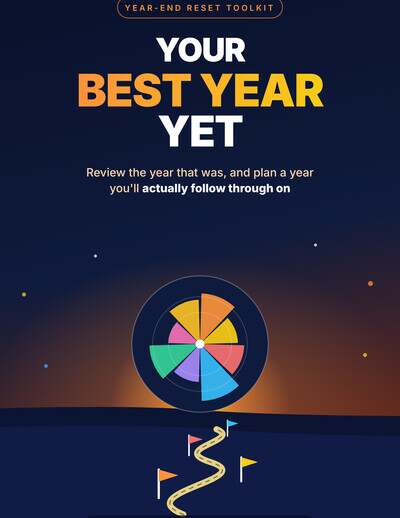
Your review shows what happened. A Life Wheel shows where you stand now. Score each of these eight areas twice from 1 to 10: once for how satisfied you feel today, and once for where you realistically want it to be in twelve months.
- Health and energy
- Work and career (or your business)
- Money
- Relationships
- Personal growth
- Fun and rest
- Home and environment
- Purpose and contribution
The difference between the two scores is your gap. Big gaps are strong candidates for your focus. Low scores matter too, because a weak area (low energy, for example) quietly makes every other goal harder. You do not need a 10 everywhere. You are looking for the one or two areas where improvement would lift everything else.
Stage 3: Choose Your Focus and What to Stop
This is the hardest step: deciding what not to do. Pick up to three focus areas for the year, and remember that three is a maximum, not a target. For each candidate, ask the lead domino question: “If this improved, what else would become easier?” The area that unlocks the most progress is your lead domino.
Then write a short stop-doing list. Commitments you have outgrown, projects that no longer fit, tasks you could delegate or automate. Even one meaningful stop can free several hours a week. Many people also choose a one-word theme for the year, such as “Focus,” “Build” or “Simplify,” and use it as a quick filter whenever a new opportunity shows up.
Stage 4: Set Goals You Will Actually Reach
Turn each focus area into one goal, then improve it. “Grow my business” becomes “Grow my email list to 5,000 subscribers by September by publishing one lead magnet a quarter and two blog posts a week.” Score each goal from 1 to 5 on six factors:
| Factor | Question to ask |
|---|---|
| Clear | Would anyone understand exactly what it means? |
| Measurable | Will I know when I have achieved it, or how far along I am? |
| Meaningful | Do I know why it matters to me, in my own words? |
| In my control | Does it depend mainly on my own actions? |
| Realistic | Does it fit my time, energy and resources this year? |
| Scheduled | Does it have a deadline, milestones and a first step? |
A total of 24 to 30 out of 30 is a strong goal. Between 18 and 23, strengthen the weakest factor first. Under 18, narrow it or break it into something smaller. It also helps to pair an outcome goal (the result you want) with an action goal (the behavior you control). You cannot control how many people buy, but you can control how many offers you make and how often you email your list.
Stage 5: Plan in Quarters, Months and Weeks
A December deadline is easy to postpone in January. Break each goal into four quarterly milestones, then decide the weekly actions that get you to this quarter’s milestone and the very first step you will take in the next seven days. Front-load the hard parts into the first quarter while motivation is high.
Once a week, take 20 minutes to plan. Put the specific actions for each goal in your calendar like appointments with yourself, before the week fills up with everyone else’s priorities.
Build Habits and Check In All Year
Goals give you direction. Habits get you there. Start each new habit in a version so small it feels almost too easy, attach it to something you already do (“after I pour my coffee, I write my top three priorities”), and plan for obstacles with simple if-then rules (“if I miss a day, I restart the next day”).
Most plans do not fail in January. They fade in March when nobody is checking in. Protect yours with three rhythms:
- Weekly review (20 to 30 minutes): what you got done, what got in the way and your top three priorities for next week.
- Monthly check-in (about an hour): rate progress on each goal, compare it with where you expected to be and adjust.
- Quarterly reset (half a day): review milestones, re-score your Life Wheel and set the next quarter.
When you fall behind, and everyone does, follow one rule: never miss twice. Shrink the habit back to its tiny version rather than quitting.
Use AI as Your Planning Partner
AI assistants such as ChatGPT, Claude, Gemini and Copilot are surprisingly good planning partners. Ask one to interview you with your year-in-review questions one at a time, paste in your notes and ask what patterns it notices, have it turn a vague goal into a measurable one, or ask it to suggest quarterly milestones and a weekly plan. Keep the decisions yours, and leave out sensitive details such as account numbers or medical records. AI is a planning partner, not a financial adviser, doctor or therapist.
Do It All in One Year-End Reset Day
| Time | What to do |
|---|---|
| Morning (about 2 hours) | Calendar walk-through, year-in-review questions, top three wins and lessons, Life Wheel scores |
| Midday | A real break away from your desk |
| Afternoon (2 to 3 hours) | Choose focus areas and theme, write and check goals, build quarterly milestones, schedule your reviews and plan week one |
Why New Year Planning Is the Perfect Lead Magnet Right Now
If you build an email list, this topic is worth more than your own plan. Interest in goal setting and planning climbs every December and peaks in early January. It is one of the few topics almost everyone cares about at the same time, whatever their niche. Coaches, consultants, course creators, wellness and productivity brands and business educators can all offer a year planning gift that fits their audience naturally.
A good seasonal lead magnet catches that wave. It gives people a quick, personal result (their own plan for the year), it builds trust right when people are open to change, and it leads naturally into whatever you sell next, from coaching to courses to software.
Get the Whole System as a Free White Label Kit
Your Best Year Yet packages everything above into a done-for-you kit with White Label rights, so you can use it yourself and put your own brand on it to grow your list. It is free to claim with a free Automated List Profits account. Inside you get:
- The Best Year Planner AI tool: review your year, score your Life Wheel (with a live chart of now and target scores), choose your focus, run the goal check, build a quarterly roadmap and record monthly check-ins. It also creates an AI brief you can paste into any assistant.
- The Best Year Coach AI agent: an installable skill for ChatGPT and Claude, plus a Copy and Paste edition for any AI, that guides year reviews, goal setting, weekly planning and check-ins.
- A Best Year Readiness quiz opt-in page to capture subscribers.
- The full 10-chapter report and cheat sheet.
- 28 AI prompts, 7 follow-up emails, social posts and graphics to promote it.
- A White Label Owner Kit with a rebrander, license and delivery files.
Rebrand it and give it away during December and January, sell it as a low-cost planning product, add it as a bonus, or drop it into your course or membership as a New Year module.
Want a fresh kit like this every month? Automated List Profits delivers done-for-you lead magnets, AI tools and follow-up emails with White Label rights, and there is a special offer on our Black Friday deals page. Looking for more? See all 10 free gifts from PromoteLabs.
Keep reading
Frequently Asked Questions
How do I plan my best year yet?
Review the year you just had, score eight life areas to find your biggest gaps, choose up to three focus areas, check each goal on six factors, break goals into quarterly milestones and weekly habits, then protect the plan with weekly reviews and monthly check-ins.
What is the Goal Check?
It is a six-factor test for goals: clear, measurable, meaningful, in my control, realistic and scheduled. Score each from 1 to 5. A total of 24 or more out of 30 is a strong goal.
How many goals should I set for the year?
No more than three. One or two well-chosen goals that you work on every week usually change a year more than a long list of resolutions.
What should I do when I fall behind on my goals?
Never miss twice. Shrink the habit back to its tiny version, look for the cause in your system rather than blaming yourself, and adjust the next quarterly milestone instead of abandoning the goal.
Can AI help me plan my year?
Yes. AI assistants can interview you with review questions, spot patterns in your notes, sharpen vague goals and suggest milestones and weekly plans. Keep the decisions yours and avoid sharing sensitive personal details.
Is there a free year planning kit I can use?
Yes. Your Best Year Yet is a free New Year planning kit with White Label rights, including the Best Year Planner AI tool and the Best Year Coach AI agent. Claim it with a free Automated List Profits account.
DOWNLOAD & SAVE THIS POST >> CLICK HERE <<